Preserved Arlington mill may be one of a kind
Boston Sunday Globe, January 18,1970
by Joan Mahoney

An oval wooden picture frame was mailed from the Old Schwamb Mill in Arlington to a customer in Los Angeles the other day.

It may have made history.

O, not to the eye, perhaps. As far as anyone could see, it was a graceful, delicately-molded frame, fashioned of creamy, unfinished birch wood. It was made by hand, with techniques new to this country 122 years ago.

But that frame was the first to be made and shipped by the Old Schwamb Mill since its closing and apparent death last summer. And while the Old Schwamb Mill is the last manufacturer in the country of custom-made oval and circular wooden picture frames, it may become the first example of industrial preservation in Greater Boston.

Watch that phrase, now. It's "industrial preservation," not restoration. This isn't going to be an antique showcase, with tools on display and neat signs on the machinery, telling what it was once used for.

The Old Schwamb Mill is going to be a working mill, with saws and lathes humming and whirling, workers in dusty aprons and caps bending over workbenches, glue warming gently in thickly smeared old pots, and a stream of picture frames being shipped out to antique dealers and decorators, frame shops and artists' studios, museums and art galleries all over the country.

All of this action will continue in the original mill building, a rusty-red clapboard structure which once had its own mill pond, one of a chain of such ponds dotted along Arlington's Mill Brook.

Is such preservation - which packages both the industry and the buildings which have always housed it - valuable? You bet. Here's what one of the Old Sturbridge Village historic researchers who is interested in the mill has to say about it:

"This totally unique five-generation business is valuable now as a technological and economical monument of industrial history, physical evidence of a small family-owned craft industry once so common, but now nearly gone from New England.

"In a sense, it is priceless now, but in 100 years, it if is preserved in its present completeness, it promises to be the only thing like it in this country..."

A dramatic concept, right? But not nearly so dramatic as what's gone on in Arlington since last June, as Arlingtonians worked to save the mill.

If it were a movie, you'd call it The Schwamb Mill Story, and it would start with the day in 1847 when the Schwamb brothers, Charles and Frederick, members of a German family which had emigrated to America, bought a spice mill in Arlington. There they carried on the family tradition of working in wood, with techniques brought with them from Europe, and they specialized in circular and oval wood picture and mirror frames and lengths of carved molding.

The film flashes by: generation after generation of Schwambs inherit and run the mill. Little of the mill changes, though the water power which once turned the lathes gave way to steam and then to electricity.

And then, the crisis: last May, the family business ended. The fourth-generation owner, Elmer C. Schwamb, sold the property to a nearby trucking firm. The mill was doomed; it was to be razed the new owners said, and would give way to a storage building.

One of the few residents in Arlington who knew what the community would lose when the mill was razed is Mrs. John A. Fitzmaurice. She was particularly interested in the mill, for the Arlington Conservation Commission, of which she is an associate member, had discussed the mill and hoped to preserve it. Before the commission could move, however, the purchase and sale agreement had been signed. The mill, it seemed, was gone.

Undaunted, though dismayed by the news of the sale, Mrs. Fitzmaurice turned to Dr. Richard W. Hale Jr., acting chairman of the Mass. Historical Commission at the State House, and to four of her colleagues in conservation for help.

They added up to a group with a formidable amount of knowledge about historic preservation and restoration. Dr. Hale, an historian, as Archivist of the Commonwealth; Dr. Philip S. Thayer is chairman of the Conservation Commission; Miss Doris E. Atwater, an active conservationist; David D. Wallace, an architect; and - what was needed most just then - a Boston attorney, Rudolph Kass.

So the fight to save the Old Schwamb Mill began. With a second attorney, William S. Abbott of Arlington, and former mill owner Elmer C. Schwamb, the group formed The Schwamb Mill Preservation Trust, a non-profit charitable - educational trust with one goal: to acquire and maintain the mill as a "working industrial museum."

The trust has gone into legal procedures, raised money, and kept a steady report of the activities before Arlingtonians in local newspapers. Mrs. Fitzmaurice herself has had the three mill buildings and their contents evaluated for their historic importance by professional staff members of the Smithsonian Institution, Old Sturbridge Village, and the Society for the Preservation of New England Antiquities, as well as the Mass. Historical Commission. On their advice, a film documenting the buildings and the manufacturing process was begun and nearly completed before the buildings were slated for demolition early in September.

Since then, the trust has entered into a purchase and sale agreement on the principal mill building and has arranged to rent the smaller buildings from the new, or "interim", owners. A major drive is now under way to raise the mill's $30,000 purchase price.

The sale to the trust was scheduled for yesterday.

Only a week or so ago the best news yet; two Boston groups had each voted $7500 to the mill. The trustees of both the Sarah A. Hyams Fund and the Committee for the Permanent Charity Fund wrote that their gifts were conditional upon the raising of the rest of the total purchase price of $30,000, but those gifts represented the first half of the total, and so were a substantial boost to the trust.

At the moment, the trust is running the mill, assisted by the former owner and two former employees. With the mill back in operation, picture frames are once more being shipped out. Schwamb Mill frames grace not only the major museums of the country, but also the White House; perhaps Old Schwamb Mill frames, made under trust management, will join their distinguished predecessors.

Mrs Fitzmaurice scarcely found time to send out Christmas cards this year, but she is preparing to mail out a batch of brochures far more important. They are announcements to former and future customers that the mill is once more in operation under the direction of the Preservation Trust "to preserve this technological and economical monument of New England industrial history."

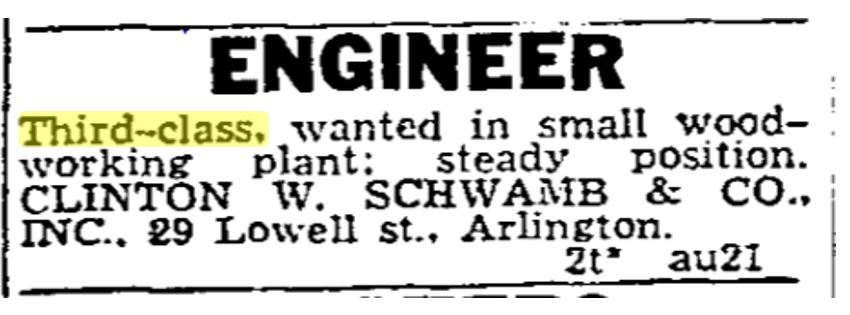
Noting that "Our goal is a working industrial museum," the brochure spots the mill "on the Revolutionary Battle Route to Lexington and Concord, 17 Mill Lane at 29 Lowell St.., Arlington." And it contains, interestingly, a photograph of the mill back in the 1800's, looking very much as it does today, and handsome enough to frame.

In a Schwamb Mill frame, of course - what else?


Research and History - Main Page |  Time Period: 1650-1846 |  Time Period: 1846-1969 |  Time Period: 1969-Present |  Articles |  Timeline |  Producing a Frame |  How the Lathes Work |